A Hobbesian darkness animates the narrative that bolsters law enforcement’s political legitimacy. Danger lurks everywhere, we’re told, and each of us, at any moment, might find ourselves victimized in a menacing world where everyone, left to their own devices, will indulge their natural-born instinct to engage in the English philosopher’s “war of all against all” that renders life “nasty, brutish, and short.” Violence is nature’s decree, and we ought always to be afraid.
Ushering men and women away from this state of nature and toward the reward of civilization is a “leviathan” that rescues us from ourselves by promising order, safety, and security. Without this regime’s badge-wearing, gun-carrying frontline agents, we’re taught in America, chaos would engulf us: Police officers protect us from each other while absorbing the violence otherwise meant for us. In exchange for their service, we offer tribute that transforms suffering into glory.
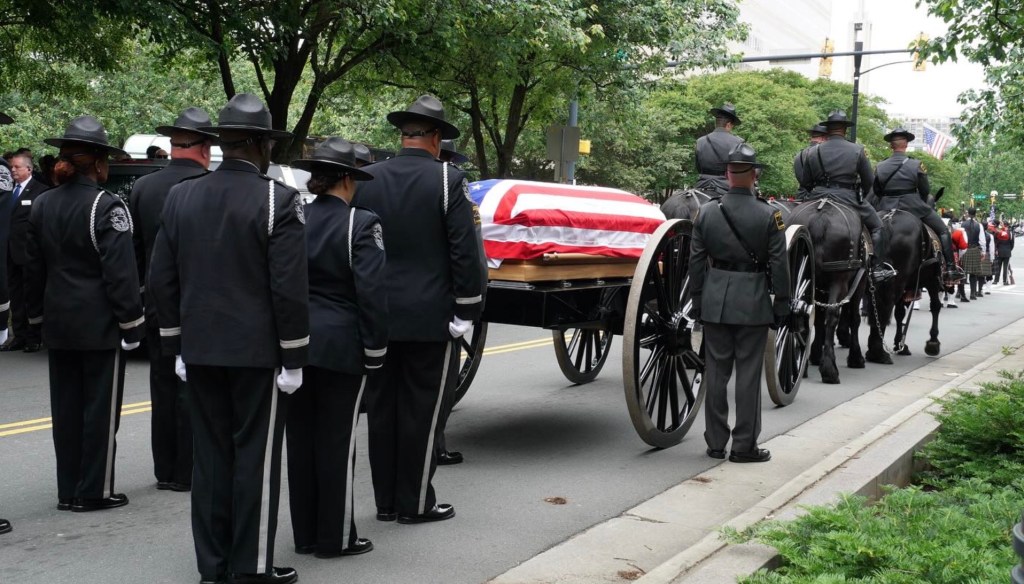
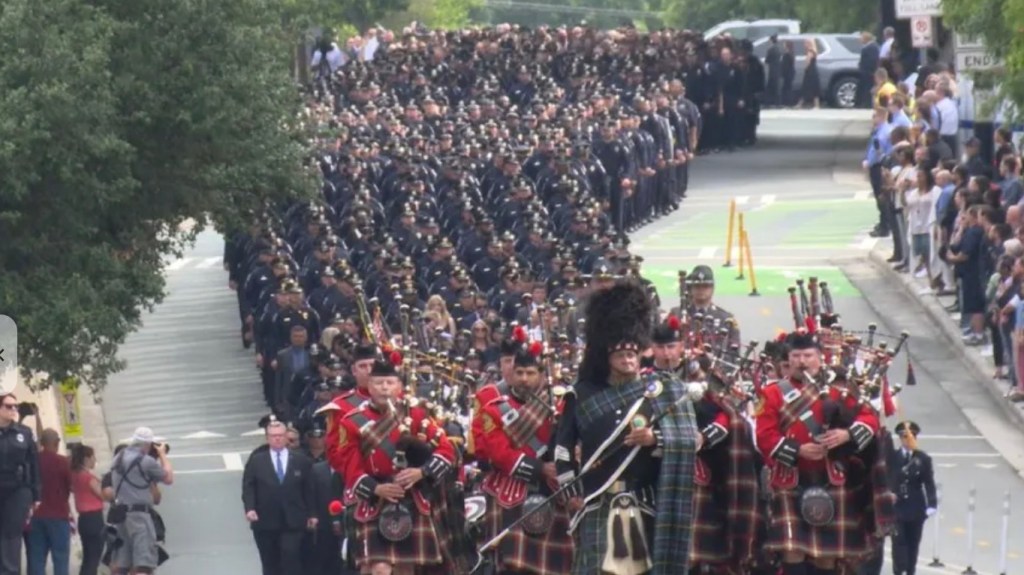
It’s a tale made compelling because it occasionally achieves plausibility. Cops are sometimes struck down in the line of duty. Such a moment visited Charlotte last month when a man wanted for possession of a firearm by a felon shot and killed four law enforcement officers who attempted to arrest him: one from the Charlotte-Mecklenburg Police Department, two from the North Carolina Department of Adult Corrections, and one from the U.S. Marshalls Service. Four other officers were wounded. Police shot and killed the suspect.
There on the streets of east Charlotte arrived confirmation of the dangerous world in which we live and the willingness of law enforcement officers to bravely stand in the gap at great cost to themselves.
But while it took great personal courage for officers to race to the scene so they could render aid to their colleagues in what had become a free-fire zone, we shouldn’t mistake a rare event as a common occurrence.
Mythology can comfort, but the truth matters: If we are to be a free, self-governing people that makes sober-minded, clear-eyed decisions about our common lives, if we are to be something other than a fear-fueled half-mast society that prioritizes pathetic, performative mourning of the sort that numbs the critical faculties necessary to achieve democracy, then we need to be guided by facts, not fables, especially when confronted with political narratives that tend to prop up the powerful and well-positioned by distorting our view of the world.
Of course, good taste counsels that we not press our politics too forcefully in the immediate wake of tragedy, but we also know that reciprocity is fair play: If, while the community is reeling, partisans to a contested political question enter the public square to make a political argument, they can’t rightly object if those with a contrary perspective meet them there to offer a refutation.
Just hours after the wanton killing of those four police officers last month, The Charlotte Observer lamented the prevalence of guns in our society before asking everyone to save those and similar concerns for later. “[T]here will be a time for other questions and conversations about what happened and why. For now, we must come together as a community to share pain and honor lives lost,” the editors wrote. Politics, the newspaper suggested, should wait a bit. Let us first grieve and begin to heal.
Less than a week later, the Observer made a different choice. In an article riddled with distortions wrought by missing context and a failure to make fine distinctions, the newspaper enlisted itself as an ally in law enforcement’s efforts to promote its political position by furthering the mostly false narrative of dangerousness on which contemporary policing depends for its prestige.
Start with the headline: “More NC police officers are getting killed on the job. What keeps them going?” In the wake of the east Charlotte shooting, “killed” suggested the officers shot to death suffered something that “more” cops across North Carolina have recently experienced: not just death, but murder. We were implicitly invited to think of police officers as perpetually under siege by gun-wielding assailants and asked to understand last month’s slaughter not as the exception to most hum-drum police work, but as the bloody rule.
To support its assertion that “[m]ore NC police officers are getting killed on the job,” the Observer pointed to data compiled by the Officer Down Memorial Page showing that since 2014, 80 cops across the state were “killed on duty”: 2 in 2014, 1 in 2015, 2 in 2016, 6 in 2017, 9 in 2018, 2 in 2019, 17 in 2020, 25 in 2021, 9 in 2022, 3 in 2023, and 5 in 2024.
The data’s details, which were omitted from the piece, tell a different story than the one suggested by the article.
Roughly half of the fatalities since 2014 — 39 out of 80 — were caused by COVID: Any recent spike in deaths was mostly attributable to a once-in-a-century public health crisis, not the dangers of law enforcement. And these officers were not killed: “Killed” is different than “died.” Killed suggests a killer and an intentional act, or at least some sort of violent trauma like an automobile accident.
The next largest cause of death — 18 out of 80, or nearly a quarter of the fatalities — was, in fact, car crashes, including four deaths when officers were struck by vehicles. These deaths attest not to the dangerousness of law enforcement, but to the dangerousness of driving, something shared by all workers who find themselves behind the wheel or on the roads.
There were also six heart attacks and a single “duty-related illness.” (A detention officer recovering from a broken knee developed a pulmonary embolism attributed to inactivity during his convalescence.)
Of the 80 officers in North Carolina who died since 2014, then, 80% died from disease or automobile accidents. While any on-the-job fatality is tragic, these men and women did not suffer deaths of the sort suggested by the Observer‘s framing, which was both menacing and misleading.
And what of the kinds of deaths suggested by the headline? How many cops were shot down in the line of duty over the last decade? Thirteen, or an average of about one a year across the entire state: 1 in 2014, 0 in 2015, 1 in 2016, 0 in 2017, 1 in 2018, 1 in 2019, 3 in 2020, 3 in 2021, 2 in 2022, 1 in 2023, and now 4 in 2024. (On two other occasions in 2017, four detention officers were killed by prisoners.)
While the Observer matter-of-factly told its readers that “more” police officers were “killed” in the last decade, the number of such deaths was relatively stable.
The data also contradicts the Observer’s characterization of law enforcement as “an unusually dangerous job.”
It’s true that in 2022, the nationwide fatality rate in law enforcement was 14.3 deaths per 100,000 workers, which is about four times higher than the economy-wide rate of 3.7 deaths per 100,000 workers, according to data from the Bureau of Labor Statistics, but once again, the story lacked essential context.
The most deadly job in the American economy is logging, which has a fatality rate of 100.7 deaths per 100,000 workers, according to the same data cited by the Observer. Other especially dangerous occupations include roofers (57.5 deaths per 100,000 workers); construction helpers (38.5 deaths per 100,000 workers); and drivers/sales workers and truck drivers (30.4 deaths per 100,000 workers): The people building apartments and delivering Amazon packages across Charlotte have deadlier jobs than do police officers. So do garbagemen (22.6 deaths per 100,000 workers) and fishers, farmers, and hunters (20.0 deaths per 100,000 workers).
Jobs with fatality rates similar to law enforcement — though each of these occupations is actually a little deadlier — include electric power line installers and repairers (14.9 deaths per 100,000 workers), maintenance workers (14.9 deaths per 100,000 workers), and car mechanics (14.7 deaths per 100,000 workers): Cops face slightly less on-the-job danger than the workers who keep on your lights, fix your AC, and repair your cars.
When we hold state funerals for cops but not garbage men or roofers or truck drivers — the “unskilled” detritus of a cruel economy that encourages us to treat manual laborers as disposable — it isn’t because law enforcement is a deadlier job; it’s because law enforcement is engaged in a political project founded on the repeated retelling of an aggrandizing folk tale that shapes fear into cultural and political power: Beleaguered officers, ever and always pinned down on all sides by dangerous, violent criminals, are sacrificing themselves to keep us safe. With the telling of this story, passion replaces virtue as the essence of heroism; democratic habits of mind and character are degraded amidst the worship of official violence and its perpetrators; and ostentatious public farewells exploit real loss to create a sense of grandeur rooted in policing’s preferred narrative of dangerousness, the dissemination and promotion of which tends to discourage or blunt criticism of policing while amplifying the encomiums of law enforcement’s supporters and apologists who seek to transform suffering into political clout by invoking inchoate impressions of a thin blue line.

 Charlotte Citizen
3 replies on “Politics Through Tragedy”
Okay so by you logic we shouldn’t honor military members because the FY21 on-duty ground Soldier fatality rate was 1.3 fatalities per 100,000 Soldiers (according to http://www.army.mil) or firefighters who are at 2.5 per 100,000. According to you they deserve to honored even less than police officers. Of course you brought up the fact that on duty deaths aren’t always violent. You gave two examples so let’s talk about them. Number 1 auto crashes, Well officers very often drive fast to get to serious calls so that they can maybe help someone. You also said officers were struck by vehicles which very often happens when an officer is on the scene of a crash possibly trying to save a life. Oh yeah and you brought up health related deaths. Now I’ll ignore the COVID stats you cited except to say that law enforcement didn’t get to sit behind a computer at home during COVID like I assume you did so the chances of exposure was significantly higher and I’ll just address the heart attacks. You clearly don’t know anything about trauma. According to the CDC the average American will experience 1 to 2 traumatic events in their lifetime, the average police officer experiences that in a week. Seeing that much trauma takes a physical toll on people which leads to heart conditions and mental health issues. That why the average lifespan of an officer after retirement is about 5 years. Your article is clearly flawed for a lot of reasons but I’ll tell you the most disturbing and disgusting one. You want to say we honor police officers for politics, that we fudge statistics to inspire fear (which is rich coming from someone who works for the news media) but you forgot one word that negates all you petty stats political nonsense. Sacrifice. We honor fallen officers because they are heros. When everyone else is running away, they run toward the danger. When a car smashes into a tree officers drive like hell to get there and help. When a veteran calls the suicide crisis line an officer shows up to comfort and provide. Police officers show up to work every day to knowing it could be the worst day of someone’s life and they have to be the difference. Officers sacrifice their time, sanity, comfort, bodies, and lives to make our society better and safer. This article is shockingly ignorant and tasteless which shows why you are writing for the Charlotte Citizen you quack!
LikeLike
well done anonymous! You appear to be better suited to editorializing than this faux journalist.
LikeLike
I’m pretty sure this guy could suck all the air out of a room listening to himself blaber….
LikeLike