No matter how hard he strives for celebrity, a politician shouldn’t be judged by the standards of a Tiger Beat cover boy.
Jeff Jackson, a Democratic congressman from Charlotte who’s running for state attorney general, first entered public office in 2014 when party members named him to a vacant seat in the North Carolina Senate.
Later that year, he earned some good publicity for a floor speech criticizing the GOP’s proposed state budget. His critique became a minor sensation among people of Jackson’s political ilk who were desperate for someone to vent their frustrations over the Republican Party’s dominance of the General Assembly.
Jackson’s success as a social media phenomenon began in earnest the following year when he documented a snow day at the General Assembly during which he was the only legislator who showed up.
Using the hashtag “#JustOneLegislator” on his Facebook page and Twitter account, Jackson spent his time at the legislative building that day describing the sort of agenda Democrats would enact if voters returned them to power.
“Just came back from the Senate chamber. All votes were unanimous,” Jackson posted. “Medicaid = expanded. Teachers = paid. Film = jobs. What’s next? This is going to be like ‘Night at the Museum’ except at the end we’ll have a stronger middle class.”
Jackson as imaginary lawmaking lone ranger established an independent commission to draw legislative districts, subsidized childcare, invested in clean energy, funded early childhood education, protected the state’s public universities, and expanded mental health treatment and rural broadband access. It was enough to make a liberal’s heart flutter. (Full disclosure: Jackson was a year behind me at Chapel Hill’s law school. We took, I think, one class together and were both members of the trial team. I’ve briefly spoken to him twice in the last fifteen years and contributed to one or two of his political campaigns.)
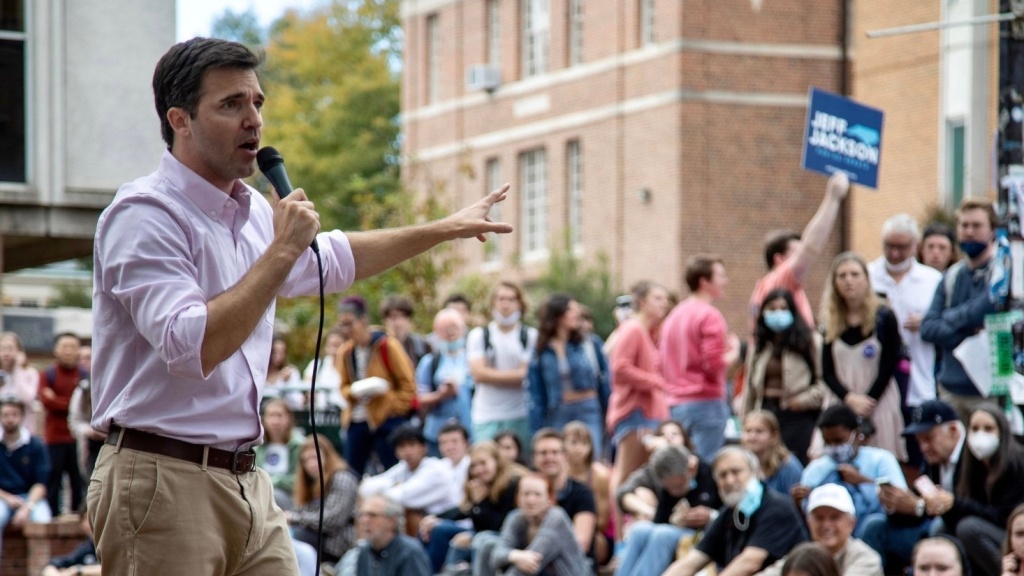
Local and national media, including Buzzfeed, picked up the story, and a social media darling was born, one who would win reelection to the state senate four times, launch an unsuccessful bid for his party’s nomination for a U.S. Senate seat in 2022, win a U.S. House seat that same year after congressional districts were redrawn by court order, and earn the Democratic nomination for state attorney general in 2024, a contest that pits him against Dan Bishop, a Republican congressman and Donald Trump sycophant.
Along the way, Jackson gained 2.5 million followers on TikTok and used the platform to publish popular, matter-of-fact videos explaining the work of Congress in everyday, ordinary language. Millions have seen his posts; an April 2023 video about the failure of Silicon Valley Bank has more than thirty million views.
So strong is Jackson’s identification with TikTok, which is owned by the Chinese company ByteDance, that when he announced his candidacy for attorney general, Bishop, in a remark tinged with xenophobia, welcomed him to the race as a “Chinese social media star.”
With his relative youth, good looks, nice-guy demeanor, and earnest approach to his craft — a cool, calm, and collected anti-Trump in the vein of Transportation Secretary Pete Buttigieg — Jackson’s appeal extended beyond the boundaries of the Tar Heel State, earning him an appearance on The Daily Show and sparking a fire in the breasts of fanboys across the social media landscape.
Then came a recent vote to force the sale of TikTok, and admiration borne of celebrity now threatens to become resentment borne of betrayal.
On March 13, by a vote of 352-65, the House passed a bill that would require TikTok’s owner to either sell the platform or face a ban in the United States. Lawmakers who supported the legislation argued that allowing TikTok to remain in the hands of a Chinese company poses a threat to national security.
Jackson was among those who voted for the bill, and he took to the platform to explain his position. (The explanatory video has since been removed from TikTok, according to WRAL, though it’s still available on Jackson’s Twitter feed.)
“I don’t think TokTok is gonna be banned,” he said. Rather, if the bill were to pass the Senate and be signed into law, the social media company would likely be sold. (Bishop voted against the bill and said that while he believes it’s ill-advised to use the app, he thinks the legislation violates the First Amendment. TikTok expressed the same perspective and has promised a court fight if the bill becomes law.)
Jackson detailed the national security concerns animating the proposal. Chinese law requires the company to follow orders from the government’s intelligence services, he explained, which could require the platform to tinker with user’s feeds to propagate misinformation that hurts the United States and helps China. Concerns about misinformation issuing from TikTok weren’t merely hypothetical, he said, but had already been vindicated: While the House was considering the bill, TikTok users got a pop-up message encouraging them to take political action to prevent the app’s shuttering, which, Jackson said, wasn’t under consideration.
Some of Jackson’s followers melted down after the vote, accusing him of hypocrisy or worse for voting against the interests of a social media platform that helped facilitate his political rise. He quickly lost about 200,000 followers, and some users did what they do best: transformed their anger into performance and entertainment — animated, in this case, by a merciless standard that equates imperfection with worthlessness.
In a jig called “The Bastard in the Kitchen,” one called Jackson a “withered soul” with “shit behind his eyes.” (It looks like the video is now off TikTok, but it’s up on YouTube.) Another scolded Jackson with an Outkast pardoy: “I’m sorry, Jeff Jackson, I thought you were real.” And yet another, in a forty-second song now seen 1.6 million times, called Jackson “a liar,” “a cheat,” “a fraud,” “a Judas,” and a “good-for-nothing ne’er-do-well.”
The criticism on social media kept piling on, so Jackson, perhaps sensing the kind of damage to his public persona that he can ill-afford ahead of a tight race in the fall, took to TikTok two days after the vote to offer a mea culpa.
“I apologize. I did not handle this situation well from top to bottom, and that is why I have been completely roasted on this app over the last forty-eight hours, and I get it. If I were in your shoes, I would probably feel the same way,” he said.
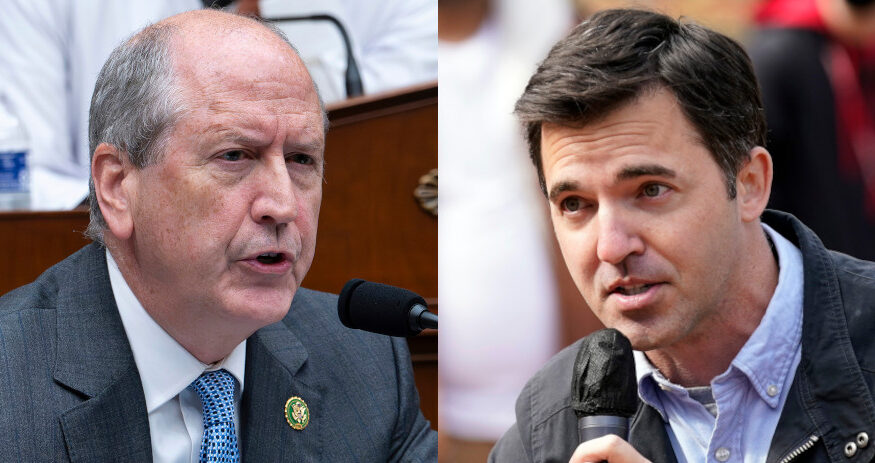
Jackson explained that while TikTok helps him communicate with people, he’s gotten congressional briefings about the app that are “genuinely alarming.” He supported the bill, he said, because forcing TikTok’s sale would allow its continued use in the United States while eliminating the threat of the platform being influenced by an “adversarial government.” Jackson said he thinks there’s “practically zero” chance TikTok will be banned and took responsibility for not doing a better job of initially explaining his vote. Then he apologized again.
Of the 82,000 comments on Jackson’s apology post, which has 5.4 million views, some expressed appreciation for his candor, but for others, it was too late: Jackson had stumbled, and unforgivably so. No amount of contrition or explanation will matter to some of his embittered former followers.
But why? Why is a single vote on a bill that may go nowhere generating such heat? Why is a left-leaning Democrat facing abandonment by like-minded people who, until a couple weeks ago, fairly swooned at his feet?
Go back to the song calling Jackson a Judas. It’s opening line: “I think I just got dumped by Jeff Jackson.” Dumped. But Jackson isn’t our fiance or boyfriend. He’s not even our casual hook-up. He’s our congressman, and he’s asking to be North Carolina’s next attorney general. We aren’t scorned lovers, but constituents of a candidate who, if elected, has promised to bring into our department of justice the same solidly Democratic perspective he’s articulated as a legislator, a political vision profoundly at odds with his opponent’s record and presumably consistent with the politics of the now-disaffected Jacksonians.
In the race for attorney general — not political idol or social media heartthrob — Jackson’s opponent voted to overturn the 2020 election and continues to carry water for Donald Trump, serving on extremist Congressman Jim Jordan’s subcommittee on the so-called weaponization of government, the only purpose of which is to whitewash the misdeeds of the former president and impede the administration of the current one. On his campaign website, Bishop vows to reject “progressive ideology” and work as a “constitutional conservative” who will support the actions of cops and prosecutors to “help restore order to our cities,” a conservative trope and racist dogwhistle that equates urbanity, including the connotation of Blackness, with lawlessness and violence. And as a state legislator in 2016, Bishop sponsored the odious House Bill 2, which stopped local governments from passing ordinances to prohibit discrimination against LGBTQ people and enacted anti-trans public policy across North Carolina.
Against this, Jackson’s angry social media followers can say only that he kinda, sorta voted against TikTok. Their ire defies explanation — unless, before the recent vote, Jackson’s online fans were feeling something toward the congressman no politician deserves: blissful adoration, which we should save for the saints, who are dead and therefore can no longer disappoint us with the fallibility that is the fate of all living people, especially politicians, who, even at their best, are not paradigms of purity, but backslappers and logrollers and dealmakers who occupy a world of pragmatic, work-a-day compromises where worshipful reverence has no place. Seen by some of his social media followers as somehow more than a mere politician — an impression from which Jackson surely hoped to benefit — the congressman exposed himself as precisely a politician, thereby puncturing the mythological hues — charismatic, fraternal, salvational, romantic, lustful — in which some had shrouded him and prompting some of his most starstruck fans to go from smitten to smiters.
The often disappointing, frequently frustrating standards of politics are the helpful ones by which to judge politicians — and judge them we should, bluntly and with an intolerance for bullshit — and by any measure of electoral politics, the choice between Jackson and Bishop shouldn’t be hard for anyone outside the ranks of MAGA Republicans.
You don’t need to love Jeff Jackson; you don’t even need to like him. He isn’t my boyfriend or best friend or schoolgirl crush. He isn’t yours either. He’s not asking to give a toast at your wedding or a eulogy at your funeral. He’s not asking to be your child’s godfather or your parent’s caretaker. He’s not asking you to join his family for dinner or on their next vacation.
Against a loathsome opponent, he’s asking to be attorney general. To make that happen, you don’t have to swoon. You just have to vote.

 Charlotte Citizen
2 replies on “Jeff Jackson Isn’t Your Schoolgirl Crush”
With the state of corruption in our govt today, voting for a democrat is the last thing we need to do. While both sides are doing damage, the democrats are doing it at a sprint.
LikeLike
Well, just read this for the first time, and now it’s January if 2026. The article was right on. I’ve voted both parties, dependant on who would do the best job with issues I care about, and for their willingness to admit errors and work across party lines. That’s what sustains a republic, and mixed a country forward.
LikeLike