Charlotte cops punched and pummeled a woman at a public bus stop on a public street, but they insisted on privacy when discussing their assault upon her, and we, as a political community, went along.
After a few of his officers beat Christina Pierre in November 2023, Charlotte-Mecklenburg Police Department Chief Johnny Jennings announced plans to convene a so-called Community & Police Collaboration Group to “collectively review certain CMPD policies and provide the organization with recommendations for consideration.” Jennings selected the group’s members — “a diverse group of stakeholders,” he said — and determined the parameters of its operations. He also decided, in an endorsement of civic meekness and a rejection of democratic courage, that its meetings would be closed to the public because, the Charlotte Observer reported, Jennings worried that “[i]f members of the group found their comments being publicized, they might feel less free to have those discussions.”
The Observer unsuccessfully pushed for the committee to open its meetings. “The group’s work is of significant public importance, and members of the public will naturally take great interest in its deliberations and ultimate recommendations, which will affect them directly,” Taylor Batten, the Observer‘s managing editor, wrote to Jennings, who ignored him.
State law requires “public bodies” that perform “advisory functions” to do their work in public because they “exist solely to conduct the people’s business.” Democracy is North Carolina’s stated public policy, and as a matter of both statutory text and democratic ethos, Jennings’s task force fell squarely within the law’s mandate.
City Attorney Patrick Baker pushed back and said the group’s meetings fell outside the scope of our Open Meetings Law because the task force is “informal,” a sterile, formalistic observation with no support in the law’s text and no relevance to the ethical and political question of how democracies should do their work. (The word “informal” appears in the law, but only to clarify that “a social meeting or other informal meeting” is exempt from the law’s requirements. A group of people convened by city officials for the express purpose of advising the city on public policy does not fall within this narrow exemption to the broad textual command of openness.)
Neither Mayor Vi Lyles nor any of our eleven city council members publicly called for the meetings to be opened up. Secrecy suited them, too, perhaps because they feared the potential political consequences of crossing law enforcement. Consider: In September 2016, CMPD Officer Brentley Vinson shot and killed Keith Lamont Scott, a Black man. The city erupted in violent protest. Then-Mayor Jennifer Roberts released a statement criticizing CMPD’s “lack of transparency and communication about the timing of the investigation and release of video footage” of the shooting and said the department’s obfuscation, which earned condemnation from, among others, the New York Times editorial page, the ACLU, and the NAACP, “was not acceptable” and should be “remed[ied] … immediately.” City Council, including then-Mayor Pro Tem Lyles, responded to Roberts’s statement by publishing a letter of its own fawning over CMPD. “We support our Police Chief and the men and women of the Charlotte-Mecklenburg Police Department, including our Chief’s continued efforts to enhance trust and accountability within the Department and within the community,” Council said. Then, in early September 2017, Roberts again earned the ire of law enforcement when she publicly called for “a full and transparent investigation” after CMPD Officer David Guerra shot and killed Ruben Galindo, who died with his hands in the air in what a federal appellate court recently described as a “position of surrender.” Just five days after Roberts once again displeased CMPD, she lost the Democratic mayoral primary — to Lyles, who has since occupied the mayor’s seat.

CMPD’s defiance of the Open Meetings Law makes sense: Secrecy is the governing class’s contempt for the people. Jennings and other responsible, respectable bureaucrats and functionaries, who, by education, training, and experience, believe themselves especially equipped to govern, while constrained to admit the technical sovereignty of the people, try to shrink democracy to a minimalist formality. The people may vote, though hopefully not too many of them will choose to do so; they may show up to complain, though hopefully not too often or too loudly or too persistently; and they may serve in limited roles on this or that committee or task force convened and monitored by careerists and professionals, though their unqualified participation in our public life must be resisted. Enlightened, informed insiders like Jennings decide when and under what circumstances and to what degree outsiders are to be given a chance to seem to govern themselves; to do otherwise and allow real self-rule would be to endorse permissiveness and chaos.
When the people are allowed to minimally participate, they must always be handled, the governing class importing into politics the ethos of the business corporations that dominate our economy and community: managerialism. The foundational assumption on which this attitude rests is that a small group of decision-makers ought to be empowered to set the terms of our common life while the rest of us are expected to deferentially follow the lead of our betters; we may wave the flag, recite the pledge, and sing the anthem, but we may never actually govern ourselves. (While he paints the picture in cartoonish colors and issues the critique in bad faith, Donald Trump isn’t wrong when he rages against a governing class that contemptuously views the people as an obstacle to be navigated. As political scientist Martin Gilens has demonstrated, “When [policy] preferences diverge [among members of different socio-economic classes], the views of the affluent make a big difference, while support among the middle class and the poor has almost no relationship to policy outcomes. Policies favored by 20 percent of affluent Americans, for example, have about a one-in-five chance of being adopted, while policies favored by 80 percent of affluent Americans are adopted about half the time. In contrast, the support or opposition of the poor or the middle class has no impact on a policy’s prospects of being adopted.” Like FDR’s “economic royalists,” Dwight Eisenhower’s “military-industrial complex,” and George W. Bush’s too-big-to-fail banks, today’s plutocrats run the show, and our professional bureaucrats, administrators, and managers serve as their obedient vassals.)
This elite perspective readily accepts authority’s primary premise: not the fact of authority, but it’s justification, a political Calvinism that teaches that those in positions of authority are so positioned because they deserve to be, their offices the outward signs of their inner worthiness and the fact of their power a testament to their right and capacity to govern.
A fatalistic darkness incompatible with democracy lurks within our supposed meritocracy: If merit decides our fates, those in power deserve to hold it. They are where they are supposed to be. The obverse follows: Those without power, position, or authority deserve their fate, too, and are exactly where they’re supposed to be. Everyone is in their rightful place in our great chain of being. The is proves the ought: “We’re up here because we’ve earned it, and you’re down there because you have, too.” An insider’s status and authority are self-validating; position and power justify themselves.
The governing class may believe its dominance over us to be fated, but, in fact, we choose our subservience. Always embedded in our public life, no matter the particular issue under consideration, is the essential question for any community that claims a commitment to self-rule: How seriously shall we take democracy? Jennings and other bureaucrats can treat the people with disdain only because, in our answer to this question, we allow them to do so, a curious choice for a people rhetorically committed to democracy. (Our choice to submit may be odd, but it isn’t necessarily atypical: In his essay On Cannibals, Michel de Montaigne recounted that visitors to France during the sixteenth-century reign of King Charles IX were asked what they found most surprising about the nation. They answered, in part, “that they had observed that there were amongst us men full and crammed with all manner of commodities, whilst, in the meantime, their halves were begging at their doors, lean and half-starved with hunger and poverty; and they thought it strange that these necessitous halves were able to suffer so great an inequality and injustice, and that they did not take the others by the throats, or set fire to their houses.” Even if forbearance before injustice frequently recurs in the human experience, it’s never eternal: Two hundred years after Charles IX’s reign, and just a decade after we overthrew our own king by a years-long revolutionary war, the French republic cut off Louis XVI’s head.)
Since we like to think of ourselves as committed democrats, Jennings couldn’t say outright that he intended to carry on without regard to the people. He had to endorse a show, if not the substance, of self-rule, so he convened “a diverse group of stakeholders” — not citizens, but stakeholders, the ideas and language of business ever and always creeping into and undermining the work of the commonwealth — to attend secret meetings where those in charge could manufacture the appearance of democracy while CMPD schemed to carry on as usual.
We now know that’s exactly what happened.
When Jennings’s committee published its recommendations in early April, one of its only meaningful proposals was for Charlotte cops to stop arresting people for marijuana use, something still technically illegal but culturally widespread and socially acceptable. CMPD’s response: No. (Rest easy, my fellow white, well-off residents of white, well-off neighborhoods like NoDa, Plaza-Midwood, and Elizabeth: You and your weed habit are safe. People who are poor or brown or Black shall bear the the brunt of CMPD’s prohibitionism.)
Among the suggestions CMPD said it’s willing to consider are a handful of milquetoast “reforms” of the sort we’ve seen before: more cops interacting with kids, more de-escalation training, more customer service training, and more implicit bias training. The core of CMPD’s power will remain unchanged and untouched. (Out of institutional self-interest, Jennings also endorsed another of the committee’s proposals: expanding the CARES program that routes certain 911 calls to teams of civilians and mental health professionals that are better equipped than lethally armed cops to address the poverty, homelessness, addiction, and mental illness that drive street crime. Charlotte started CARES as part of the city’s minimalist effort to “reimagine” law enforcement after Minneapolis cops murdered George Floyd. The small program is a practical manifestation of what it would look like to defund the police, and Jennings surely knows its widespread expansion and success would mean the end of his department as it now exists: If social workers, counselors, and medical providers are broadly allowed to tend to crime’s root causes, the demand for law enforcement in its current form would crash. To help preserve CMPD’s violence-centered, authoritarian approach to law enforcement — and to protect the institutional prerogatives of a department that received nearly $335 million in taxpayer money last year, 40% of the city’s total budget — the chief agreed that City Council should expand the program and, importantly, move it out of CMPD, which would safely rid his department of a non-violent, humane alternative to the guns and tasers and pepper spray on which Jennings’s municipal fiefdom is built.)
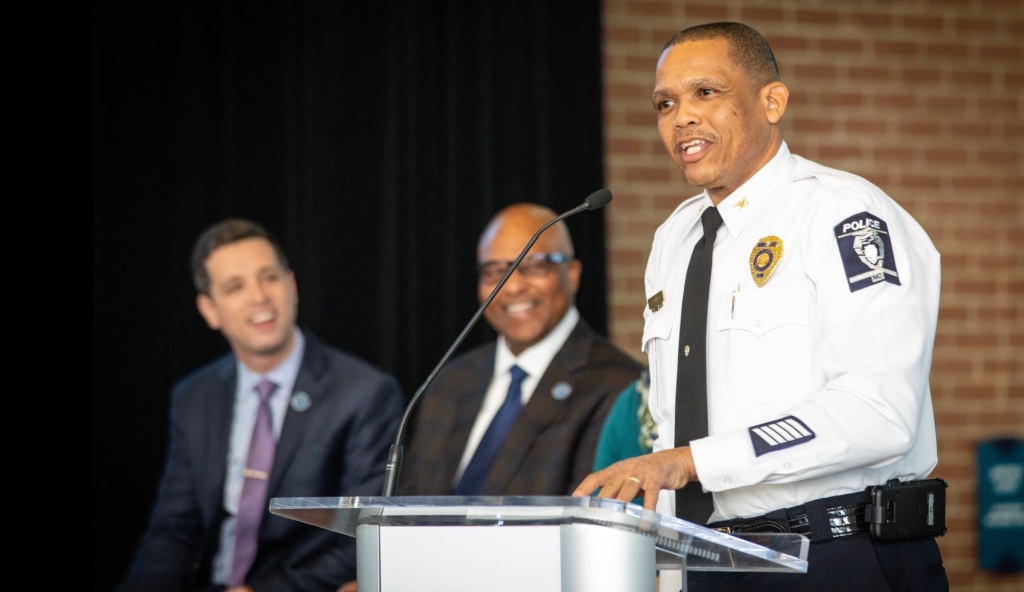
Achieving this CMPD-friendly outcome from the committee was not left to chance. Cultivating the group’s membership was a task of the greatest delicacy. The participants Jennings selected had to appear to be something other than toadies for law enforcement, but they had to be trusted to ultimately behave as toadies for law enforcement. In particular, committee members had to be willing to adopt as their own CMPD’s preference for secrecy — either because they were eager to serve as confidential handmaidens to the governing class or because they genuinely believed that being at the elbow of power, despite the inevitable risk of cooptation, would be an effective way to influence the powerful.
While the latter deserve our understanding, even if we think their judgment misguided, the former deserve our contempt: They embrace the political Calvinism that underlay our supposed meritocracy, convince themselves that their personal access to power can serve as an adequate substitute for real self-rule, and count themselves part of an elite that is hostile to the attitudes, habits, and practices of democracy. Having secured their membership in the governing class — or, at least, having earned positions as advisors to the governing class — our civic elect are uninterested in fundamentally questioning the work of those who invite them to privately participate in the life of the city: Why upend systems and structures of power that bestow status? Better to preserve their own position and serve their own interests by propping up the powers that be, sometimes tinkering around the margins of their benefactors’ power to create the illusion of meaningful change, but never demonstrating genuine defiance, registering real dissent, or insisting on radical reform. Submission is their essential choice.
By these standards, Jennings made masterful appointments to his committee. The Charlotte Observer published a story in late March that told the tale: “What’s happening in Charlotte-Mecklenburg police policy meetings? No one will say.” Every committee member who spoke to the Observer ran anti-democratic interference for CMPD by choosing to make the department’s secrecy their own.
“Terry [Bradley] has asked us to have all media speak with them,” said Corrine Mack, president of the Charlotte-Mecklenburg NAACP and a member of the committee. (Bradley is the city’s deputy director of Charlotte-Mecklenburg Community Relations. Managers and bureaucrats crave control. No one may speak out of turn. The script must always be followed lest the performance be disrupted.) Robert Dawkins, another committee member and the political director for the advocacy group Action NC, also declined to share with the Observer any details about the group’s discussions. (After the committee released its recommendations, a reporter asked Dawkins if he thought any meaningful reform would come from its work. He said he didn’t. Dawkins’s resignation confirms the committee’s purpose was not to make real change, but to launder the people’s outrage so law enforcement could maintain the status quo. Dawkins’s experience also teaches us something about being managed: At least in the short term, the governing class’s demotion of democracy to a farce tends to produce defeatism.)
Mack explained that among the advocates for secrecy in the group’s work was Tonya Jameson, who led its meetings and serves as chair of the Citizens Review Board, a theoretically independent body whose charge is to hold CMPD officers accountable for misdeeds. (The Board almost never finds against CMPD, and even when it does, its decisions mean nothing because the police chief can simply ignore the Board, rendering its work a political illusion designed to create the appearance, but not the reality, of accountability.)
When asked by the Observer, where she used to work as a reporter, why the group’s meetings were closed to the public, Jameson explained, “These are difficult conversations and people need to feel comfortable talking honestly without fear that their comments will be publicized.” She also said her “default is typically confidentiality.”
Bias against openness makes sense in communities where elites are entitled to privately debate public questions before presenting as a fait accompli whatever policy proposals result from their secret deliberations, but it axiomatically has no place where the people govern themselves. Real democracy is raucously and publicly deliberative, especially when the conversations are difficult.
Jameson’s preference for secrecy should not surprise. She describes herself in her LinkedIn profile as a “consigliere,” which fairly announces her hostility to democracy, a manner of common living that, unlike a mafia family, has no room for well-connected, unaccountable advisers to privately whisper in the ears of the powerful, but is instead premised on robust, wide-open, and public debate of those things important enough to capture and require a community’s attention.

The promotion of such democratic practices cannot detain a consigliere, whose primary obligation is to safeguard her own access to power, whoever may hold it and however they may wield it. A consigliere’s imperatives thus run to apologetics, not criticism, for a consigliere without access to power, which might be cut off were she to become a forceful public critic, is no consigliere at all. Her self-preservation ultimately commands complicity in all that power prescribes.
Our governing class and the consiglieri like Jameson who serve it see our world as one in which their paternalism is justified. They know; we do not. They understand; we do not. They see how our community works and what must be done to keep it working; we do not. Closed-door deliberations among a knowing elite rightly replace community conversations among common citizens. Indeed, our governing class can easily come to believe that its private discussions are public conversations: At the press conference called earlier this month to release the committee’s recommendations, Jameson said, “I am always encouraged that Chief Jennings invites the community to have conversations to try to work with CMPD to improve policies.” But he didn’t “invite[] the community to have conversations.” With Jameson’s support, he purposefully shut the public out and rejected calls to let it in. Jameson confused her own involvement for the community’s, and, when praising the chief, she mistook herself and her colleagues for the people.
In all of this, the governing class fails to take seriously the idea of democracy and instead adopts amoral mantras like Jameson’s: “It’s not about what you want. It’s about what are you willing to do to get it.” This combination of expressive individualism and striving, self-interested instrumentalism, Thoreauvian means to achieve Andrew Carnegian ends — more, more, more for my unique, authentic self! — defines the poverty of the political perspective that dominates our city, a politics crafted by, and attuned to, the narrow aspirations and interests of cultural and financial elites and members of the well-credentialed, well-connected professional class. We, as a community, have rejected any boldly democratic vision for ourselves and settled for the pallid promise of a timid technocracy administered and overseen by an insular governing class that meets, talks, and works in private while the rest of us are expected to obediently await its wise direction.

 Charlotte Citizen
3 replies on “Secrecy, Submission, and CMPD”
[…] for the people is widely distributed among our elected officials, high-ranking bureaucrats, and well-connected members of the governing class, perhaps no one personifies it like Assistant City Manager Tracy Dodson, whose duties as director […]
LikeLike
I’m new to both this site and Charlotte, but I have a background as a retired police detective. I’d like to gain some insights into how to assess an officer’s stability and professionalism. Recently, I had an encounter with Captain Gallant that left me feeling belittled and insulted. Another officer mentioned that this is a common experience for them as well. It seems like there may be underlying issues that need to be addressed, especially since I’ve heard she may have some protection due to her marriage to a chief. I would appreciate any advice or resources you might have on how to navigate these situations constructively. Thank you!
LikeLike
Public meeting laws need to be changed per your comment about “informal” (legislative intent isn’t about the ‘vibe,’ it’s about the content of the meeting) but also all meetings should have VERBATIM MINUTES. The law should be changed. Between common sense, the need for accuracy which is the purpose of the law in the first place, and the ease of accurate note taking with programs that require mere verification and a little occasional correction, there’s no excuse for avoiding literal audio recordings and verbatim transcripts of all government meetings. Storage is no longer an issue, either. The “minutes” are meaningless as-is: “Board went into session. Board discussed several issues. Board adjourned.” suffices as minutes now. That is clearly NOT meeting the intent of the law to have a clear record of the meeting. It should say what was discussed, who said it, what the outcomes were.
LikeLike